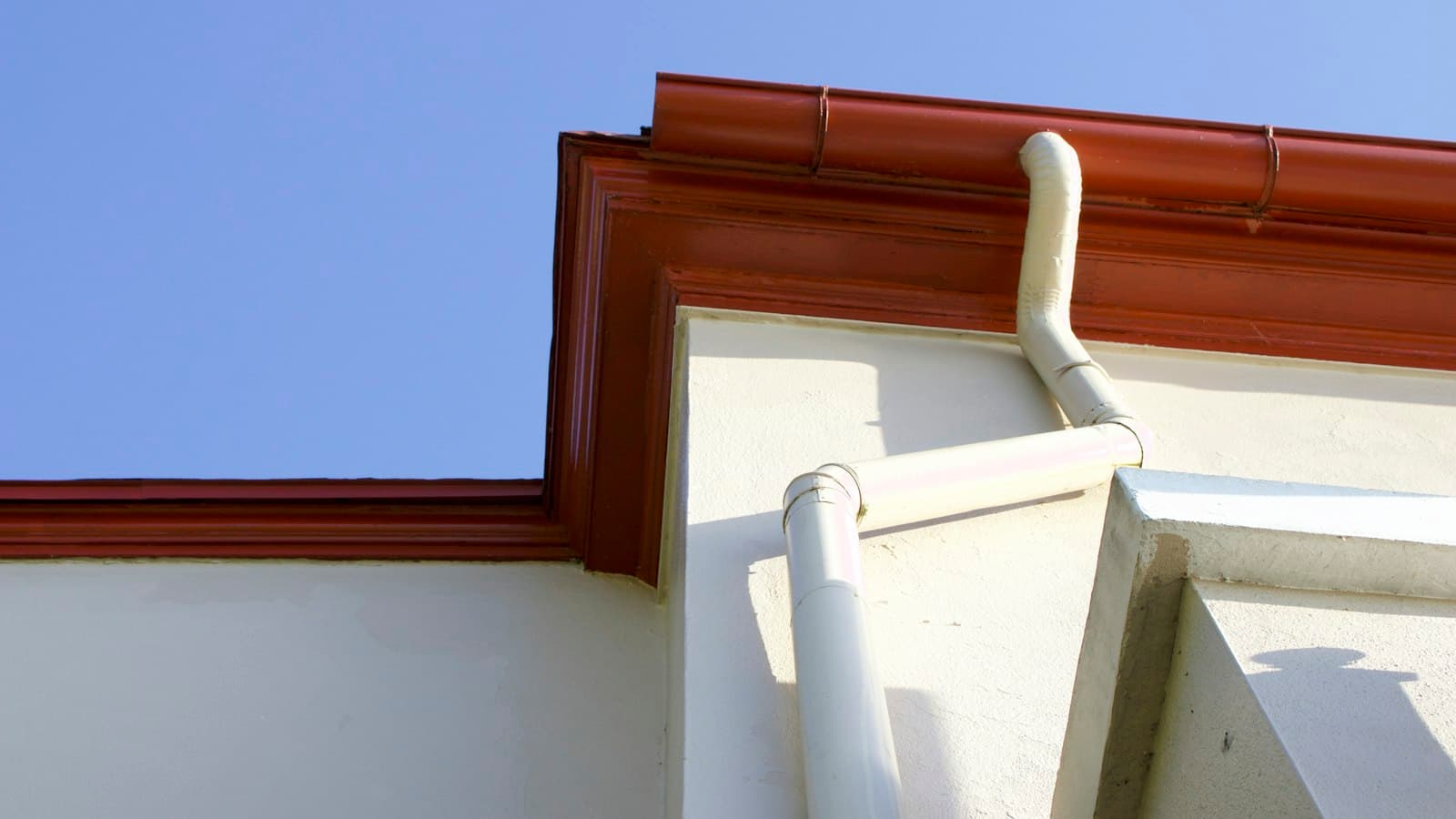
What each part of the roofline does
The fascia is the board fixed across the ends of the rafters. It carries the gutter brackets and supports the bottom edge of the felt or membrane, so the last course of slates or tiles drains into the gutter. The soffit closes the underside of the overhang between the fascia and the wall, and on many houses it is also where the roof gets its air. The gutters and downpipes take the water from the whole slope and put it into the drain instead of down the wall.
Some older houses have little of this: cast iron gutters on brackets fixed to the rafter ends or into the wall, with no deep fascia at all. The same questions apply, but on a period house the answer is more often repair and repaint than replace.
Signs that patching has stopped making sense
Walk round the house on a wet day and again on a dry one. Replacement starts to make sense when you find several of these:
- Soft or split timber in more than one place along a run, or paint failing along its whole length
- Gutter brackets that will not hold a screw because the board behind them has rotted
- Leaks at several gutter joints, or water standing along a run because it has lost its fall
- Gutters that overflow in heavy rain even when they are clear
- Felt at the eaves that has perished, so water from the bottom course runs behind the gutter and down the wall
- Gaps in the soffits where birds, squirrels or wasps get into the roof
- Old plastic that has turned brittle and chalky, or capping boards hiding timber nobody has seen for years
What is behind the fascia decides the job
When an old fascia comes off, the ends of the rafters are seen for the first time in decades. Years of water from a leaking gutter or perished eaves felt can leave them soft, and sometimes the wall plate they sit on as well. Those ends carry the new fascia and every gutter bracket, so rot there is repaired, usually by splicing new timber onto the sound part of the rafter, before the new boards go on. Ask how this will be handled before work starts, so a discovery on the day becomes a decision you have already made.
This is also the time to sort out the eaves. Where the old felt has rotted back from the edge, a short eaves carrier tray under the bottom course takes the water cleanly into the gutter. New boards fitted without fixing that detail leave the same water running behind them.
Gutter size: the reason to replace rather than copy
Approved Document H, the Building Regulations guidance on drainage, gives the largest roof area each common gutter size should drain. For a level half-round gutter with a sharp-edged outlet at one end, its Table 2 allows 37 square metres of effective roof area for a 100 mm gutter with a 63 mm outlet, 53 square metres for a 115 mm gutter, and 65 square metres for a 125 mm gutter with a 75 mm outlet. The effective area allows for pitch: the plan area of the slope is multiplied by 1.29 for a roof at 30 degrees and by 1.5 at 45 degrees.
The same document says gutters should be laid with any fall towards the nearest outlet, and set so that any overflow in exceptionally heavy rain is discharged clear of the building. A gutter that overflows when it is clean is often too small for the slope it serves, typically a long rear slope with one downpipe, or a run that also takes the water from a valley. Replacing that like for like repeats the problem. A deeper profile or a second outlet cures it, and a roofline replacement is the easiest time to do either.
Keep the air path at the eaves open
Most houses with insulation laid on the loft floor have what Approved Document C calls a cold deck roof, and it says the requirement for such roofs is met by ventilating them. The air usually comes in at the eaves. Old timber soffits sometimes had gaps that did the job by accident; a new solid soffit fitted tight to the wall can close them, and condensation in the loft the following winter may be the first sign.
Ask for ventilated soffit boards or an over-fascia vent, with rafter trays behind so the loft insulation cannot slump into the gap. Our guide to telling a roof leak from condensation explains what happens when that air path is lost.
Soffits, gutters and asbestos
HSE says asbestos may be in any building built or refurbished before the year 2000, and its Asbestos essentials introduction includes a drawing of where it turns up in a house. Soffits appear on it twice: as asbestos insulating board, which HSE groups with the materials that usually need an HSE-licensed contractor, and as asbestos cement, along with asbestos cement gutters and downpipes, which is normally non-licensed work for trained workers.
Neither can be identified by eye. On a house of that age with flat grey or cream sheet soffits, a sample should be analysed before anyone cuts, drills or prises them off, and HSE says asbestos analysts must be accredited by UKAS. If the soffits turn out to be insulating board, a licensed contractor removes them first and the new roofline goes up afterwards. Our guide to old garage roofs and asbestos covers asbestos cement in more detail.
Nesting birds and bats under the eaves
GOV.UK is plain that it is against the law to intentionally take, damage or destroy a wild bird's nest while it is being built or used, and it advises timing building work to avoid the breeding season. House martins build mud nests under the eaves, and sparrows and starlings use gaps behind old fascias, so roofline work on a house with active nests waits until the birds have finished.
Bats have stronger protection. All species, their breeding sites and their resting places are protected by law, GOV.UK lists repairing or replacing a roof among the activities that can affect them, and gaps behind fascias and soffits can be used as roosts. If there are signs of bats, a survey comes first, and where disturbing them cannot be avoided, a licence from Natural England may be possible.
Choosing materials, and using the scaffold once
uPVC fascias and soffits need no painting and suit post-war and modern houses, such as the newer estates around Sandbach and much of Poynton. On a period house, painted timber with cast iron or cast aluminium gutters keeps the character. In a conservation area, such as the one around Sandbach's market square, or on a listed building, swapping traditional materials for plastic can need the council's agreement, and Cheshire East Council's planning team can tell you whether it does.
Roofline work on a two-storey house is usually done from a scaffold, and a scaffold standing on the pavement needs a licence from the highway authority. If the roof itself will need work in the next few years, doing the roofline at the same time avoids putting the scaffold up twice; if the roof is sound and one run has failed, a repair is the honest answer, and sometimes a gutter only needs clearing. Our guttering, fascias and soffits page lists the work we do, and the quote page is the place to ask us to look at yours.
| What you find | Usually the answer | Why |
|---|---|---|
| One soft section of fascia | Cut out and splice in new timber | The rest of the board still holds its fixings |
| Rot along most of a run | Replace the run and check the rafter ends | Patches will not hold new gutter brackets |
| One leaking gutter joint | Fit a new union or reseal it | The run still falls to its outlet |
| Leaks at several joints, or standing water | Rehang or replace the gutter | The fall or the brackets have gone |
| Overflowing even when clear | A bigger gutter or another outlet | Too small for the roof area under Approved Document H |
| Old sheet soffits on a pre-2000 house | Have a sample tested before any work | Asbestos insulating board usually needs a licensed contractor |
| Brittle, faded plastic but no leaks | Replace when the scaffold is next up | Mostly cosmetic until it cracks |
Need this done? See our guttering, fascias and soffits page or gutter cleaning, or ask us for a quote.
Questions we get asked
Do I need planning permission to replace fascias, soffits and gutters?
Usually not, when the new roofline looks much like the old one. On a listed building, or in a conservation area, replacing timber or cast iron with plastic can need consent, so check with the council before ordering materials.
Should new soffits be vented?
Yes, if your loft is insulated at ceiling level and relies on air coming in at the eaves. Approved Document C expects cold roofs to be ventilated, and a solid soffit fitted tight to the wall can cut that air off.
What size gutter does my house need?
It depends on the roof area draining into it and its pitch. Approved Document H allows up to 37 square metres of effective roof area for a level 100 mm half-round gutter with an outlet at one end, 53 for 115 mm and 65 for 125 mm.
Can you replace soffits that might contain asbestos?
Only once you know what they are. A sample is analysed first; asbestos cement can be removed by trained workers following HSE's guidance, but asbestos insulating board usually needs an HSE-licensed contractor before the new roofline goes up.
When is the best time of year to replace the roofline?
Outside the nesting season if birds use your eaves, because active nests are protected by law, and in dry weather if new timber is being painted. Otherwise it can be done for most of the year.