Why two quotes for the same roof can be far apart
Most of the difference between quotes is not profit, it is scope. One roofer prices new battens, a breathable membrane, new lead and ventilation at the eaves; another prices re-laying the old slates on the old battens. Both call it a new roof. Until each quote lists what is being replaced and what is being kept, you are comparing two different jobs.
The rest comes from how each roofer reads the risks: how much of the timber they expect to be sound, how long the scaffold will be up, and how much of the old slate they think can be saved. A roofer who has been up on the roof, or at least into the loft, can price those risks. One working from a photo has to guess, and the guess is usually high or turns into extras later.
What sets the price of a new roof
The area to be covered is the starting point, and it is bigger than the house's footprint: a steep roof has more surface than a shallow one over the same rooms. After that, these move the price most:
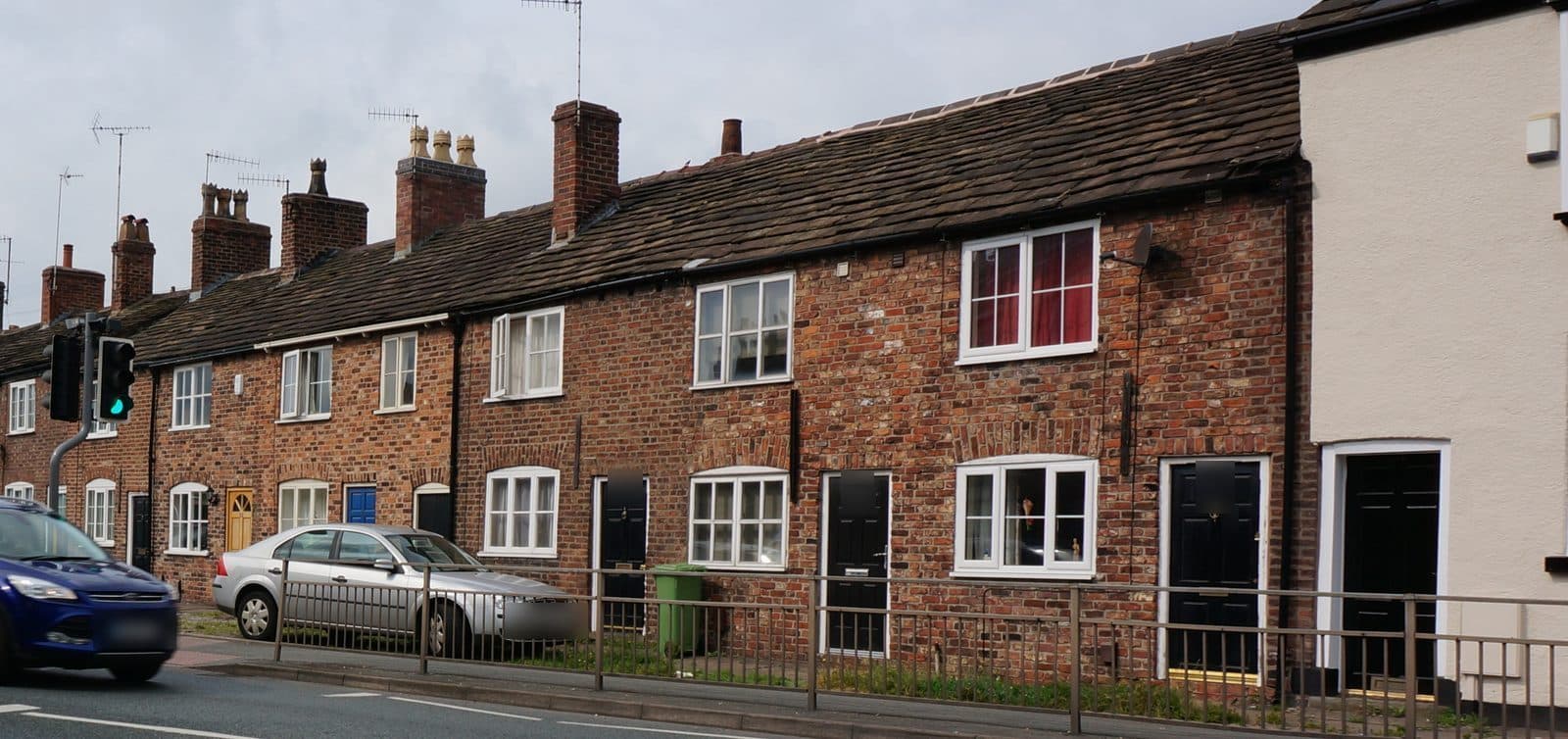
- The covering. Natural slate is laid by hand and fixed with nails, so it takes longer than concrete interlocking tiles. Stone slate, such as the heavy sandstone slates on older terraces and cottages around Macclesfield and Bollington, is the slowest and most specialist of all, and new or good reclaimed stone is hard to find.
- The shape. Every hip, valley, dormer, chimney and roof window adds cutting, lead and labour that a plain gable roof does not have.
- The scaffold. A terrace with no back access, a house on a steep street or scaffold on a busy road such as the A523 all take longer to scaffold. Scaffold standing on the pavement or road needs a licence from the highway authority, which here is Cheshire East Council.
- Taking the old roof away. Old slates, battens and felt have to be stripped and removed, and a skip on the road needs its own permit.
- Building Regulations. Re-covering more than a quarter of a roof normally counts as building work, so the job has to be signed off, either by a roofer in a competent person scheme or through the council's building control, and either route has a cost.
What sets the price of a roof repair
A repair is priced mostly on access and time, not materials. Replacing a few slates that can be reached safely from a ladder or a roof ladder is a short job. The same slates three storeys up, or anywhere near a chimney, can need a scaffold tower or a full scaffold, and the scaffold then costs more than the repair.
Finding the leak is part of the job. Water can run along a batten or rafter for some distance before it drips, so a roofer may need to look from the loft and the roof before pricing the fix. Lead flashings, valleys and chimney work take longer than slates or tiles because they are made and dressed by hand on site.
Costs that only appear once the old roof is off
Some costs cannot be seen until the covering is stripped. The common ones are rotten battens or rafter ends, a wall plate that has decayed at the eaves, and a chimney stack that needs rebuilding rather than repointing. Older garages and outbuildings can have cement sheets or soffits that contain asbestos, which must be handled under the Health and Safety Executive's rules and adds cost. All bats are protected by law, so if bats are found, work on that part of the roof stops until the right advice is taken.
A good quote does not pretend these cannot happen. It names a rate for them in advance, for example per metre of rafter or per day for a chimney, and says that nothing extra will be done without your agreement. That turns a surprise into a known figure.
What a written quote should include
Ask for the quote in writing and check it covers:
- Exactly what is being stripped and what is being kept.
- The covering, named by type and grade, and whether any is reclaimed.
- Battens, the membrane under them, ventilation and any insulation.
- Leadwork, chimneys, valleys and roof windows, item by item.
- Scaffold, its licence if needed, skips and clearing up.
- How the Building Regulations sign-off will be done.
- Rates for hidden defects found once the roof is open.
- VAT, payment stages, the start date and what happens if it rains.
- The guarantee: how long, what it covers and whether it is insurance-backed.
How to compare quotes and avoid the expensive mistakes
Get two or three written quotes and compare them line by line against that list, not by the total. If one is much cheaper, find the line it leaves out. Ask each roofer what they would do if the timber is worse than expected, and whether they are in a competent person scheme for roofing.
Be wary of anyone who knocks on the door after a storm, asks for most of the money before starting, only takes cash or pushes you to decide on the day. If you agree a contract at home, the Consumer Contracts Regulations normally give you 14 days to cancel. Paying by credit card for a job between £100 and £30,000 also gives you protection under section 75 of the Consumer Credit Act.
Ways to keep the cost down without cutting corners
Make the scaffold do everything once it is up. Gutters, fascias, chimney pointing and roof windows cost far less while the scaffold is already there than as separate jobs later.
Ask honestly whether the roof needs replacing. A roof with a few slipped slates and tired ridge mortar can often be repaired for years; one with nail fatigue across the whole slope usually cannot. Where the old slates are sound, a good roofer will re-use them, which suits older houses and conservation areas. And if storm damage is behind the job, talk to your insurer before the permanent repair starts.
| Factor | Why it changes the price | What to ask |
|---|---|---|
| Roof size and pitch | A steeper roof has more surface to cover | How many square metres are you pricing? |
| Covering | Slate and stone are laid by hand and take longer | What exactly is going on, and is any of it reclaimed? |
| Scaffold and access | Rear access, steep streets and busy roads add time and licences | Who arranges the scaffold licence? |
| Hidden timber | Rot under the covering only shows once it is stripped | What is your rate if timber needs replacing? |
| Leadwork and chimneys | Made and dressed by hand on site | Is the lead renewed or re-used, and what code? |
| Sign-off | Building Regulations apply to most re-roofs | Are you in a competent person scheme? |
Need this done? See our new roofs page or roof repairs, or ask us for a quote.
Questions we get asked
Why will a roofer not give me a price over the phone?
Because most of the price depends on things that have to be seen: how the scaffold can go up, what the roof is covered in and what state the timber is in. A phone price is either padded to cover the unknowns or turns into extras later.
Is VAT included in a roofing quote?
Ask, because it varies. A VAT-registered roofer adds VAT at the standard rate. A sole trader with a turnover under the VAT threshold, which has been £90,000 since April 2024, does not charge it. Installing insulation in a home is zero-rated until March 2027, so a quote may show that part separately.
How much should I pay up front?
Keep any deposit modest and tied to materials ordered for your job, then pay in stages as the work is done. Be cautious about paying most of the price before work starts, and get every payment receipted.
How many quotes should I get?
Two or three written quotes is usually enough, as long as they describe the same work. Compare them line by line rather than by the total.
Will my home insurance pay for a new roof?
Usually only for damage caused by a sudden event such as a storm. Insurers generally do not pay to replace a roof that has worn out over time.