Why winter brings both at once
Winter is when a roof takes the most rain, and around Macclesfield much of it arrives on south-westerly winds that drive it sideways into slopes, verges and chimney flashings. It is also when a house puts the most moisture into the air: windows stay shut, the heating is on, washing dries indoors and every shower and pan on the hob adds steam. Warm, damp air rises, and some of it finds its way through the ceiling into a loft that is close to the temperature outside.
On a clear night the roof covering loses heat to the sky, and its underside can drop below the temperature at which the loft air gives up its water. The moisture condenses on the felt, the membrane, the nails and the timber, and on the coldest nights it freezes there. When the sun warms the roof next morning, the frost melts and drips onto the insulation, which is how a homeowner finds a wet loft after a week without rain and reasonably decides the roof is leaking.
Higher ground gets more of both, so a house towards Rainow, Langley or the Peak District edge can show a leak and condensation in the same week. That is why the timing of the damp tells you more than the stain does.
Five checks you can make from the loft hatch
Only go into the loft if you can stand on boards or joists safely, and take a good torch. Then work through these:
- Think back over the weather. Damp found after several dry, cold days points to condensation; damp that only appears after rain, and most of all after rain on a strong wind, points to a leak.
- Look at where the wet is. A leak usually makes one wet area, below a chimney, a valley, a roof window or the place where the roof meets a wall, often with a trail down a rafter or along the felt. Condensation spreads across a whole slope and is usually worst on the north-facing side, which the sun never warms.
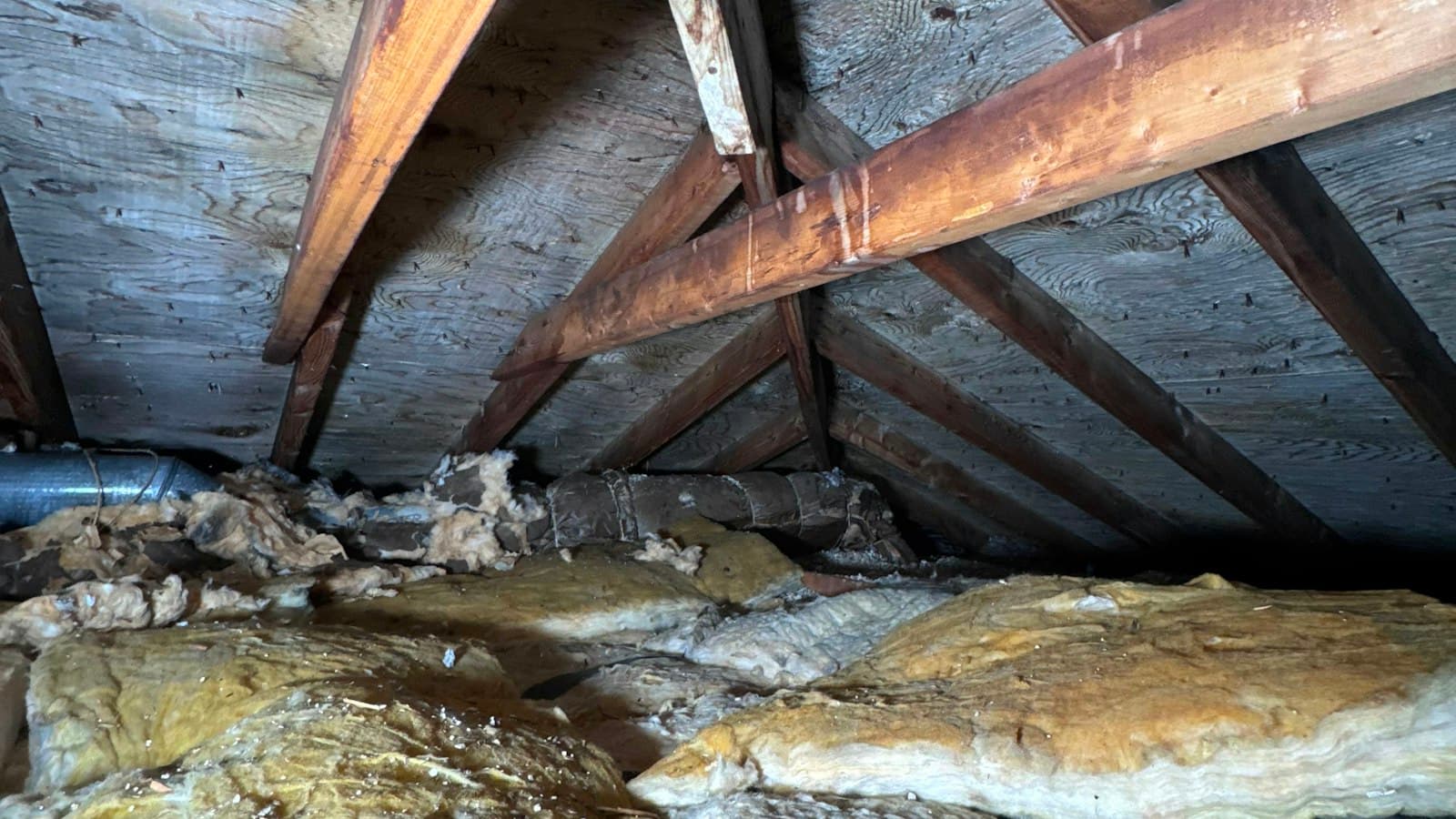
- Look at the underside of the roof. Beads of water across the whole of the felt or membrane, rusty nail points coming through boarding and black mould on the timber near the eaves are condensation signs.
- Look at the insulation along the eaves. Where it has been pushed hard into the eaves, it can block the gap that lets outside air into the roof.
- Find the bathroom fan duct and the cold water tank. A duct that ends in the loft, or has slipped off its outlet, blows steam straight into the roof, and cold pipes or an uninsulated tank can drip condensation that looks like a leak.
What the ceiling stain is telling you
A leak usually leaves a brown stain with a hard edge, because the water picks up dirt, soot and timber staining on its way down, and the ring grows a little after each wet spell. Condensation on a ceiling looks different: grey or black mould spotting, typically in the top corners of rooms on outside walls and along the line of the eaves, where the insulation above is thinnest. A brown ring in the middle of a ceiling under a valley is unlikely to be condensation, and black speckles in the corner of a cold back bedroom are unlikely to be a slipped slate.
Keep a third suspect in mind. A weeping joint on a loft tank, an overflow, a heating pipe or a shower on the floor above can wet a ceiling in any weather. Unlike condensation it does not follow the cold, and unlike a leak it does not follow the rain, so a stain that grows during a dry, mild week usually needs a plumber rather than a roofer.
Which roofs suffer from condensation, and why
The Building Regulations deal with this in Approved Document C. It says the requirement is met by ventilating cold deck roofs, meaning roofs where moisture from the building can pass into the insulation, which describes an ordinary loft with insulation laid on the ceiling. It also asks for the gaps around pipes and wiring to be filled and sealed, particularly over bathrooms and kitchens, and for loft hatches to have an effective draught seal. For the detailed design it points to BS 5250, the British Standard on controlling condensation in buildings.
Age changes the picture. Many older Macclesfield terraces still have slates on battens with no felt at all, and air moves freely through the gaps between the slates, so they tend not to trap condensation even when they let in wind-driven rain. Roofs re-covered with traditional bitumen underfelt, which lets almost no vapour through, behave differently, especially once deep loft insulation has been added: the loft gets colder, the felt holds the moisture in, and condensation appears on a roof that never had it before.
Approved Document F, the ventilation guidance, lists renewing loft insulation, replacing windows and fitting a sealed loft hatch among the energy-saving measures that can reduce a home's ventilation, and asks for the effect to be assessed when that work is done. In practice the trigger for a damp loft is often an improvement made a winter or two earlier: new windows, more insulation, downlighters cut into the top-floor ceiling, or a new bathroom whose fan was never ducted outside.
How condensation is cured
Start in the house, because no amount of roof ventilation keeps up with a bathroom pumping steam into the loft. Approved Document F asks for extract ventilation to the outside in kitchens, utility rooms and bathrooms, and its Table 1.1 sets minimum rates for fans that run intermittently: 15 litres a second for a bathroom, 30 for a kitchen with a cooker hood that extracts outside, and 60 for a kitchen without one. A fan whose duct stops in the loft is not extracting to the outside, however loud it sounds.
Then deal with the roof. The usual measures are rafter trays that hold the insulation back from the eaves so air can get in, vents at the eaves through the soffit or over the fascia, and vents high up at the ridge or in the slope so the air has a way out. Sealing the loft hatch and the holes around pipes and cables, as Approved Document C asks, cuts the moisture reaching the roof in the first place. On a roof with old bitumen felt, the lasting answer may be a vapour-permeable membrane when the roof is next re-covered.
A cold flat roof, with the insulation between the joists under the deck, can drip in winter for the same reason, and the usual cure is to rebuild it as a warm roof with the insulation above the deck.
When it is a leak after all
A winter leak is traced like any other, from the wet area in the loft to the part of the roof above it. What changes in winter is the repair. Slates can be refixed and lead dressed on a dry day, but mortar needs frost-free weather while it sets, so a ridge or a chimney may get a secure temporary repair now and its permanent one in milder weather.
If the damage followed a named storm, our storm damage guide covers the insurance side. If the leak crept in over weeks without one, it is usually wear: a slate that slipped when its nail rusted through, a flashing that has lifted, or a valley full of leaves.
What to tell us when you call
The more of this you can give us, the quicker we can tell you whether it is a roofing job at all: when you first saw the damp, what the weather had been doing, photos of the ceiling and of the loft above it, what the roof is covered in, and whether anything has changed recently, such as new insulation, windows or a bathroom. If what we find is condensation, we will say so and explain what we would change, even when most of it is not roofing work.
Our roof repairs page explains how we trace leaks, and our roof surveys page covers a written check of the roof and loft together. You can ask for either through the quote page.
| What you notice | Points to a leak | Points to condensation |
|---|---|---|
| When it appears | After rain, most of all wind-driven rain | After cold, clear nights, even in a dry spell |
| Where in the loft | One area, near a chimney, valley, roof window or wall | Across a whole slope, often the north side |
| What it looks like | Drips and trails down rafters or felt | Droplets or frost on felt and nails, mould on timber |
| The ceiling below | Brown stain with a hard edge that grows | Grey or black mould spotting in corners |
| Time of year | Whenever it rains hard enough | Mostly winter, easing in spring |
| First step | Find and repair where the water gets in | Cut the moisture from the house, then ventilate |
Need this done? See our roof repairs page or roof surveys, or ask us for a quote.
Questions we get asked
Is some condensation in the loft normal?
A little on the coldest mornings is common and does no harm if it dries out within a day or so. Wet insulation, dripping, mould on the timbers or rusting nails mean more moisture is reaching the roof than it can get rid of, and that needs dealing with before the timber suffers.
Can loft condensation stain the ceiling?
Yes. When frost on the underside of the felt melts, or droplets run down to the eaves, the water soaks into the insulation and can mark the plaster below, which is why condensation is so often mistaken for a leak.
Will more loft insulation stop condensation?
No, on its own it tends to make it worse. Thicker insulation keeps the rooms warmer and the loft colder, so whatever moisture gets up there condenses more readily. Keep the eaves clear when you top it up, and seal the hatch and the gaps around pipes and cables.
Can my bathroom extractor fan vent into the loft?
No. Approved Document F treats extract ventilation as air taken directly to the outside, so the duct should run to an outlet through a wall, soffit or roof, be securely joined, and be insulated where it crosses the cold loft.
Do tile vents or soffit vents cure condensation?
They help where the roof lacks air movement, but they cannot cope with a house sending large amounts of steam into the loft. Cut the moisture at its source first, then ventilate the roof at the eaves and high up.