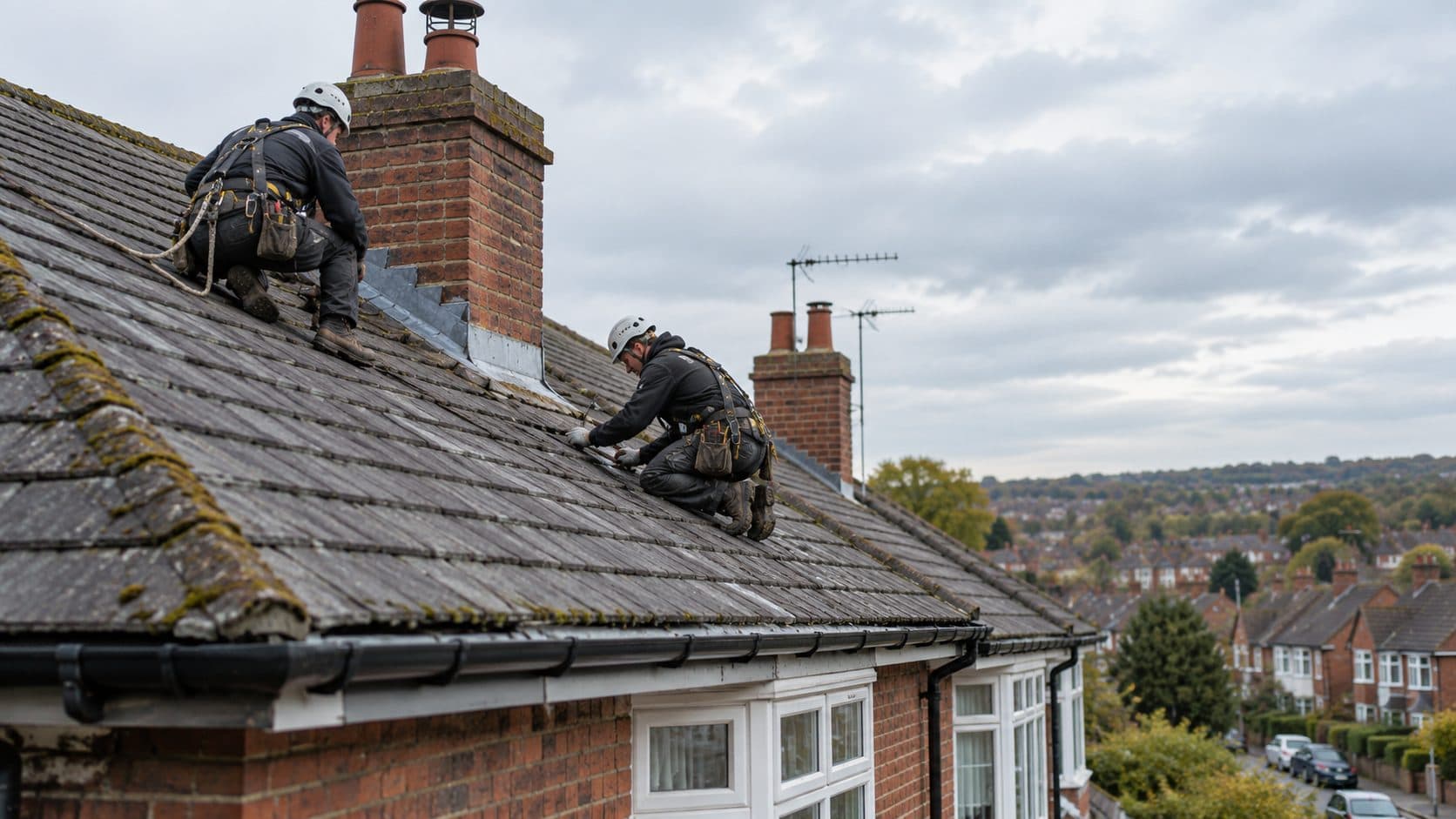
Local faults versus roof-wide failure
Most roof problems are local. A slate cracks, a ridge tile loosens, a lead flashing splits, a valley blocks with leaves. Fix that part and the roof is good for years. These are repairs, and a good roofer will tell you so even when a new roof would be a bigger job for them.
Roof-wide failure is different. When every part of the roof has reached the same age at the same time, faults start appearing all over it. Fixing one slate disturbs its neighbours, and the next storm finds another weak point. At that stage repairs stop being good value.
What to look for from the ground
Stand across the road with binoculars or zoom in on a phone photo. Look for:
- Slates or tiles out of line in many places, not just one or two
- Rusty nail heads showing, or slates hanging by one nail
- A dip along the ridge or between the rafters
- Lots of slate fragments in the gutters or on the ground
- Patches of different colour where past repairs have been made, especially many of them
- Thick moss over most of a tiled roof, which often means old, porous tiles
What to look for in the loft
If you can get into the loft safely, take a torch on a dry day and again after rain. Daylight through the roof in many places, wet or rotten battens, sagging or crumbling felt, or water marks across several areas all point to a roof that is failing as a whole.
On older houses with no felt, you will see the undersides of the slates directly. A few cracked slates are normal; widespread slipping, rusted nails and crumbling torching mortar are not.
Also look at the rafters. Dark staining, soft timber or signs of insect attack may need dealing with whether you repair or replace, and they affect the cost of a re-roof.
Different roofs fail in different ways
Natural slate roofs usually fail at the fixings, not the slates. That means a re-roof can often reuse many of the original slates, laid on new battens and membrane, which keeps the look of a period house. See our slate roofing page for how that works.
Concrete tile roofs fail as the tiles weather and become porous, and as the felt beneath them perishes. When the tiles themselves are soft and crumbling, they cannot be reused.
Flat roofs fail when water gets into the deck. A roof that feels soft or springy underfoot has a wet deck, and no surface repair will fix it; the roof needs stripping back to the joists. Our flat roofing page explains the options for the new roof.
Questions to ask your roofer
If you are told you need a new roof, ask why the roof cannot be repaired, and ask to see photos of what they found. Ask what will happen to your existing slates or tiles, whether the rafters have been checked, how the work will be signed off under the Building Regulations, and what the quote includes: scaffolding, waste, membrane, battens, ventilation, leadwork and ridges.
If you are offered a cheap repair on a roof that is clearly failing everywhere, ask how long it is expected to last. A roof survey from someone who is not quoting for the work can settle the question.
| What you see | Usually means | Usually the answer |
|---|---|---|
| One or two slipped slates | Local fixing failure | Repair |
| Slates slipping all over the roof | Nail sickness | Strip and relay or re-roof |
| A single leak at a chimney | Flashing failure | Repair the leadwork |
| Leaks moving to new places each winter | Roof-wide ageing | Re-roof |
| Soft, springy flat roof | Wet, rotting deck | Replace the flat roof |
| Cracked ridge mortar | Age and weather | Rebed or dry-fix the ridge |
Need this done? See our roof repairs page or new roofs, or ask us for a quote.
Questions we get asked
How long should a roof repair last?
A good repair on a sound roof can last many years. A repair on a roof that is failing everywhere may only last until the next storm finds another weak point.
Can a roof be partly replaced?
Yes. One slope can be re-roofed while another is repaired, for example where the weather side has worn faster. It saves money when the rest of the roof is genuinely sound.
Is it worth getting a second opinion?
On a large quote, yes. Ask for photos of the problem and, if you are unsure, get an independent roof survey.
Do I need a new roof to sell my house?
Not necessarily, but a buyer's surveyor will report on the roof's condition, and a roof needing replacement affects offers. A recent survey or repair invoice helps.