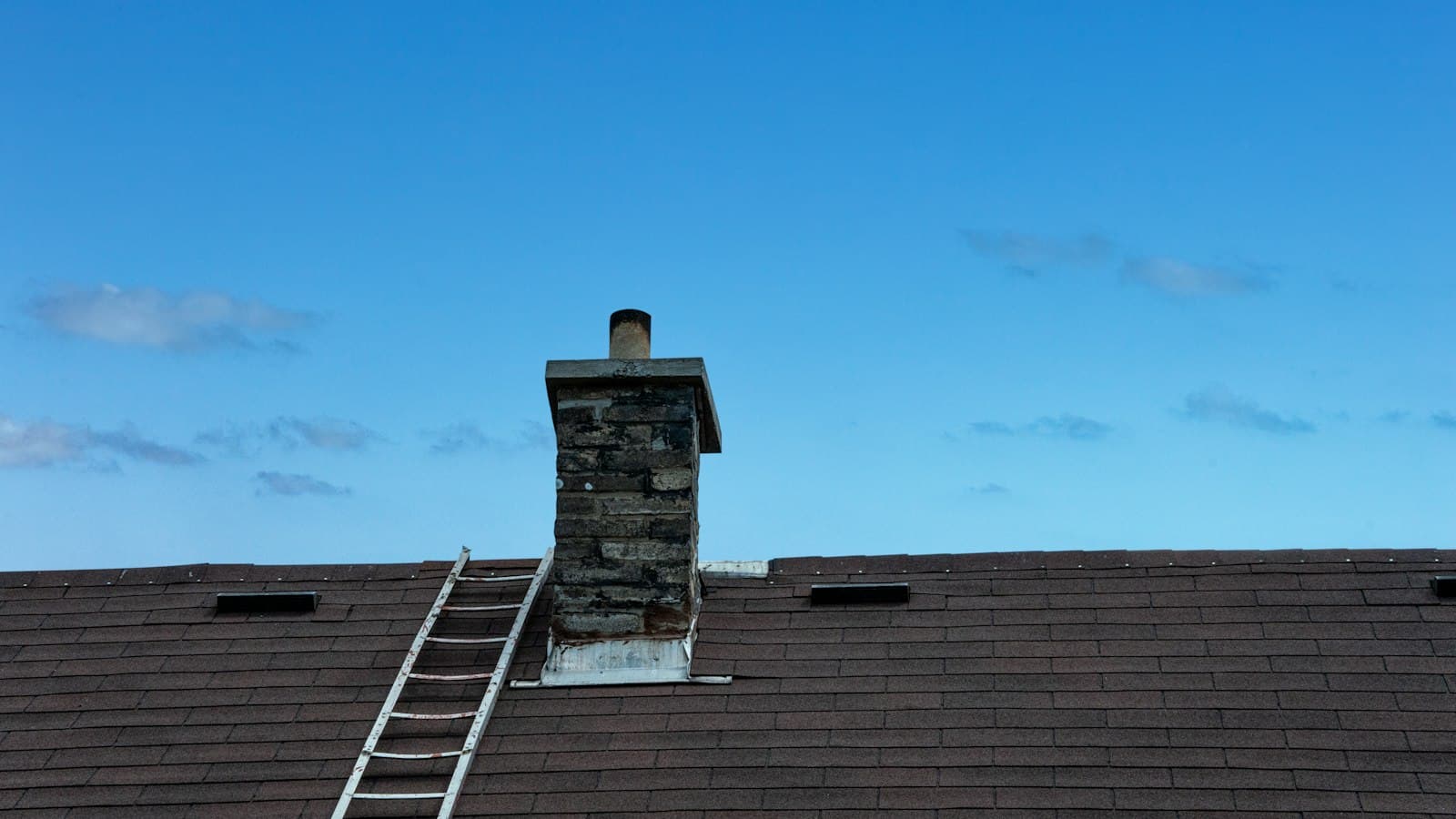
How a chimney keeps water out
A chimney stack is a column of brick or stone standing above the roof, open to the weather on four sides and on top. Three parts keep it dry. The mortar joints hold the masonry together and take the weather on each face. The flaunching on top beds the pots and throws water off. And at the base, pieces of lead join the stack to the roof: an apron across the front, soakers and stepped flashings up each side, and a back gutter behind, where all the water running down the slope above meets the stack.
Because each part faces a different kind of weather, they do not necessarily fail together, and knowing which one has gone saves paying for the other two.
Repointing: worn joints on the stack
Pointing wears from the outside in. You see it as joints sunk well back from the face of the brick, sand and grit in the gutter, mortar that crumbles under a key, and weeds or moss growing out of the stack. Water soaks into open joints and the brick around them, comes through as damp on the chimney breast, and in a hard frost pushes the faces off the bricks.
Staffordshire Moorlands District Council's leaflet on pointing, written for the traditional brick and stone buildings of the Moorlands around Leek, sets out the method well. Repoint only where it is needed: mortar that is soft and crumbly and scrapes out easily needs doing, while mortar that is firm but slightly recessed is best left alone. Rake the joints out by hand to a depth of at least twice the height of the joint, and never with power tools, which are hard to control and damage the edges of the bricks or stones. Do not point in frost or when frost is likely, because the water in fresh mortar freezes, expands and pushes the new pointing out. And on an old building, a cement mix can damage the brick and stone and speed up their decay.
Historic England's guidance on repointing makes the same point about strength: new mortar should be slightly weaker and more permeable than the brick or stone, so the joints take the weathering and can be renewed, rather than the masonry. On a Victorian stack in soft brick, a hard cement repoint keeps water in the bricks, and their faces can flake away around it.
The Moorlands leaflet adds a point worth repeating: if a building is damp but the mortar in its joints is sound, repointing will not solve the problem. On a chimney, that usually means the water is getting in at the top or at the base.
Flaunching: the cap that takes the frost
Flaunching is the bed of mortar around the base of the chimney pots, shaped to slope from the pots out to the edge of the stack. It holds the pots upright and sheds rain off the top. Because it lies almost flat, it takes rain and frost harder than any upright joint, and once a crack opens, water sits in it, freezes and widens it.
From the ground, with binoculars, look for cracks across the top, lumps missing at the corners, a pot that leans or has turned, and fragments of mortar on the roof below. Inside, damp from failed flaunching tends to show high up: on the stack in the loft, or at the top of the chimney breast in the room below. A loose pot can fall, so a leaning one needs making safe before the next windy spell, not at the next convenient visit.
Reflaunching means breaking out the old cap, lifting and checking the pots, resetting or replacing them, and forming new flaunching with a clear fall to the edge so water runs off rather than across the top. It is also the moment to deal with the flues. An unused flue wants a ventilated cap rather than a sealed one, while a flue serving a working fire, stove or boiler needs a terminal that suits that appliance, which whoever services the appliance should confirm.
Lead flashing: the joint between stack and roof
Where the stack comes through the roof, two structures meet that move differently and get wet from different directions, and the lead has to keep water out while letting both move. Soakers are laid under each slate or tile up the sides of the stack, with a stepped flashing over them, its top edge tucked into a mortar joint, held with lead wedges and pointed. The apron laps over the slates at the front. The back gutter is a small lead gutter formed behind the stack and taken up under the slates above, so the water coming down the slope is turned around the sides.
Flashings fail in a few recognisable ways. The pointing holding the top edge falls out and water runs down behind the lead. The lead splits because the piece was too long or too thin to move with the temperature. Wind lifts a loose edge. Or the back gutter fills with moss and leaves and overflows under the slates. Older repairs often replaced lead with a mortar fillet or with flashing tape, both of which tend to crack or peel away from the brick.
Lead sheet for roofing is made to BS EN 12588, and the code of practice for laying it is BS 6915, which the Lead Sheet Training Academy's manual endorses. Lead is sold by code, a number that rises with its thickness, and heavier codes are generally used for the pieces that take more weather. Where the lead itself is sound and only its pointing has gone, the repair is small: rewedge the top edge and repoint it. Split, patched or missing lead is replaced.
Doing the work safely and at the right time
Raking out joints, reflaunching and dressing lead all need both hands and firm footing beside the stack, which in practice means a chimney scaffold on the roof or a full scaffold from the ground. HSE describes the purpose of the Work at Height Regulations 2005 as preventing death and injury from a fall from height, and expects such work to be properly planned, supervised and carried out by competent people. Because access is such a large part of any chimney job, it makes sense to check all three parts while the scaffold is up.
Timing matters for the mortar. Repointing and reflaunching wait for frost-free weather, so a stack that starts leaking in January may get a repair to its flashing straight away and its mortar work in spring.
Two legal points can affect a chimney job. GOV.UK lists repointing brickwork and repairing or replacing a roof among the activities that can affect bats, and all bat species and their roosts are protected by law, so a stack near mature trees or with open gaps may need checking first. On a listed building, changing the mortar, the pots or the shape of the stack can need listed building consent, and in a conservation area taking a stack down can need permission, so agree it with Cheshire East Council's conservation officer before work starts.
Stone stacks on the hills
Around Bollington, Rainow and the Peak District edge, many stacks are built of local sandstone or gritstone rather than brick, and they face more wind and rain than stacks in the middle of Macclesfield. They were built with lime mortar, and they suffer most from later repairs in hard cement. The Staffordshire Moorlands leaflet singles out strap pointing, raised ribbons of hard mortar spread over the faces of the stones, as harmful: it holds water against the stone and stops moisture leaving the wall. On a stone stack the repair is to rake out by hand, repoint in lime and keep the mortar back from the faces.
Our chimney repairs page lists the chimney work we carry out, and our leadwork page covers flashings and back gutters in more detail. To have a stack looked at, ask through the quote page.
| What you see | Usually means | The repair |
|---|---|---|
| Damp on the chimney breast after heavy rain | Failed flashings or an overflowing back gutter | Repoint, refix or renew the lead and clear the back gutter |
| Damp high on the stack in the loft, pots leaning | Cracked or missing flaunching | Reflaunch and reset or replace the pots |
| Sand in the gutter, joints sunk back from the face | Worn pointing | Rake out by hand and repoint where needed |
| Brick or stone faces flaking away | Frost damage, often around hard cement pointing | Replace the worst units and repoint in a softer mortar |
| Brown stains that come and go in dry weather | Salts and condensation in a disused flue | Ventilate the flue at the top and bottom |
| Damp only in wind from one direction | Pointing or flashing on the windward face | Check that face first |
Need this done? See our chimney repairs page or lead flashing and leadwork, or ask us for a quote.
Questions we get asked
What is flaunching on a chimney?
It is the sloped bed of mortar around the base of the chimney pots, which holds them in place and sheds rain off the top of the stack. When it cracks, water gets into the top of the stack and the pots can work loose.
How do I know if my chimney needs repointing?
It needs repointing where the mortar is soft and crumbly and scrapes out easily with a key; mortar that is firm but slightly recessed is usually best left alone. Sand in the gutter and weeds growing from the joints are the other signs to look for.
Should my chimney be repointed in lime or cement mortar?
On an old brick or stone stack, use lime or another mortar slightly weaker and more permeable than the masonry, as Historic England advises, so the joints rather than the bricks take the weathering. A hard cement repoint on soft brick can make the brick faces fail.
Is a mortar fillet as good as lead flashing?
On a brick stack, usually not. A fillet is rigid, so it tends to crack away from the brickwork as the stack and roof move, while properly sized lead can move without opening up.
Why is my chimney breast damp when it has not rained?
Often because of salts left in the brickwork of a disused flue by years of coal fires, which draw moisture out of the air, or condensation inside a flue that has been sealed. Venting the flue at the top and bottom usually helps, once the flashings and flaunching have been ruled out.