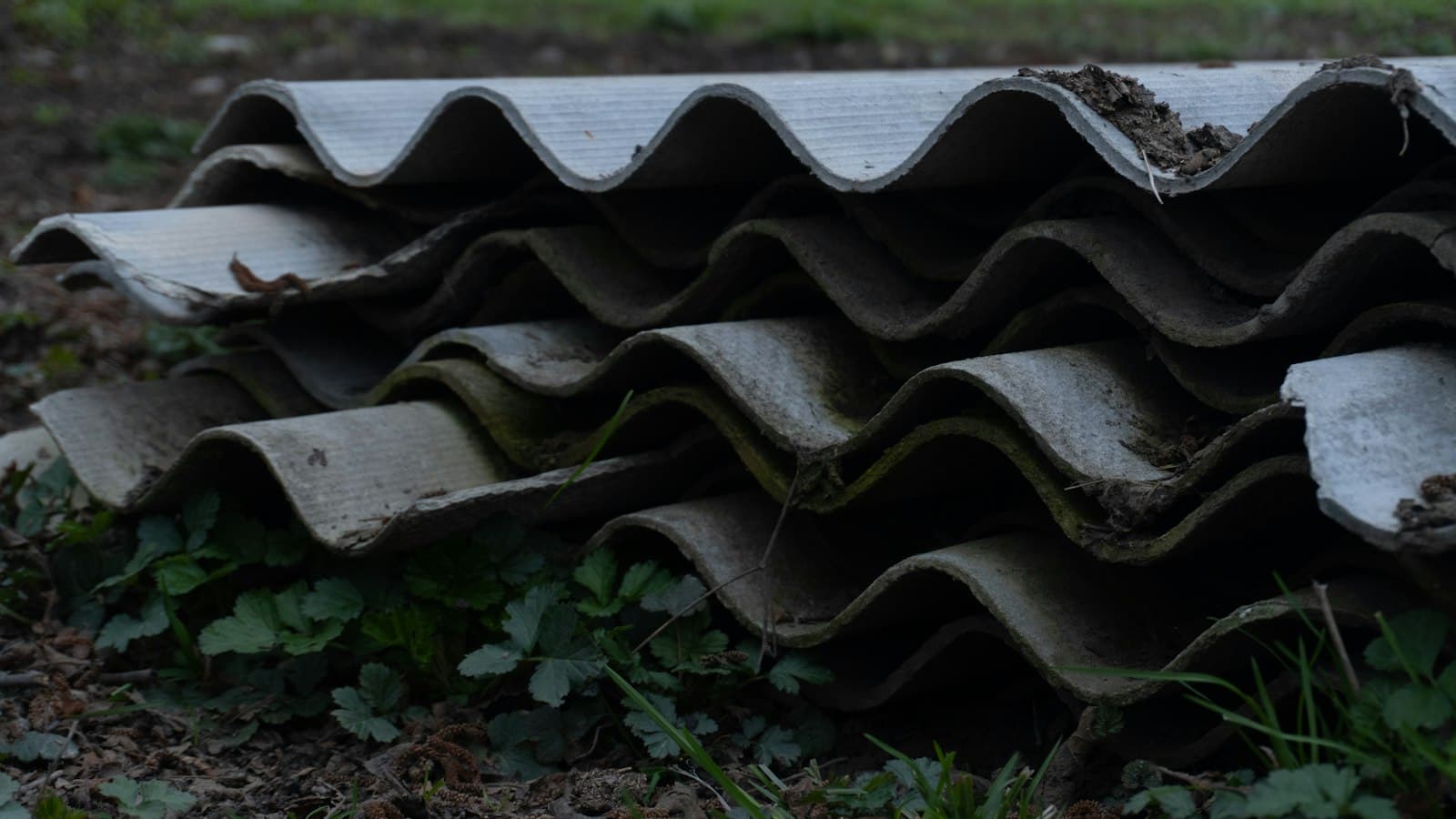
What an old garage roof may contain
HSE's introduction to its Asbestos essentials guidance sets out the dates. Large amounts of asbestos went into new and refurbished buildings before 2000; blue and brown asbestos were banned in 1985, and the manufacture and supply of all asbestos was banned by the end of 1999. Products already in place could stay in use, which is why HSE's FAQs say asbestos may be part of any domestic building built or refurbished before the year 2000.
On a garage the usual suspect is the roof: profiled cement sheets, often on a prefabricated concrete garage or across a brick one. HSE's drawing of where asbestos is found in a home also shows asbestos cement gutters and downpipes, asbestos cement panels and soffits, and roofing felt, all normally non-licensed, and asbestos insulating board soffits, which usually need a licensed contractor.
Sheets made since the ban look much the same, so age, colour and profile are clues, not proof. HSE says an asbestos survey will usually involve sampling and analysis, and that analysts must be accredited by UKAS. In a home, HSE's guidance also allows the contractor to presume a material contains asbestos and take the matching precautions instead of testing it, which is a reasonable choice when the roof is coming off anyway.
What not to do with an asbestos cement roof
HSE's guidance gives a short list of things nobody should do while the sheets are in place:
- Do not climb onto the roof or lean a ladder against it to reach across. HSE's task sheets warn that asbestos cement roofs are always fragile and cannot bear weight, and falling through one is an immediate danger.
- Do not jet-wash it to shift the moss. HSE's sheet on cleaning weathered asbestos cement roofing says high-pressure jetting is appropriate only in exceptional circumstances and needs a specialist contractor.
- Do not drill, cut, sand or break the sheets. HSE says asbestos cement should not be broken up into smaller pieces.
- Do not sweep up fragments or dust. HSE's guidance is to use damp rags or a Class H vacuum instead of a brush.
- Do not put pieces in the household bin, a general skip or a builder's bag. Asbestos has to be disposed of as hazardous waste.
- Do not try to repair or remove it yourself unless you have had training for non-licensed asbestos work. That is HSE's own advice to homeowners, and it strongly encourages the use of trained professionals.
Who may remove asbestos cement sheets
HSE divides asbestos work into three categories, and the category depends on the material, its condition and what is being done to it.
Licensed work is for the higher-risk materials: any work on sprayed asbestos, most repair or removal of asbestos insulation such as pipe lagging, and most work on asbestos insulating board. Only a contractor holding an HSE licence may do it. Asbestos cement is not on that list.
Non-licensed work covers most work on asbestos cement, provided the workers have had the right information, instruction and training. HSE includes removing asbestos cement sheeting and rainwater goods where the material is carefully handled and removed without breaking up, and that includes sheets that are weathered but not otherwise substantially damaged. Its task sheet a14 covers this job: removing asbestos cement sheets and gutters, and dismantling a small structure such as a shed or garage, as long as the sheets stay intact. Like all asbestos work, it needs a risk assessment and the right controls.
Notifiable non-licensed work applies when the sheets are substantially damaged or will be broken up, creating significant dust and debris, and HSE's own example is dropping an asbestos cement roof. The employer must notify the work before it starts on HSE's online form (HSE is the enforcing authority for domestic premises), mark the work area, and make sure the workers have had medical examinations, repeated at least every three years, with records kept for 40 years.
Two things follow for a homeowner. A garage roof in asbestos cement does not normally need a licensed asbestos contractor, but it does need someone trained for non-licensed asbestos work who follows HSE's method, and a roofer without that training should not be taking it off. And if the garage also has asbestos insulating board, in the soffits or as a lining, HSE's sheet a14 no longer applies and that material goes to an HSE-licensed contractor.
How the sheets come off: HSE's method
HSE's sheet a14 sets out the steps a trained contractor follows, and it makes a fair checklist for any quote you are given:
- Check that asbestos cement is the only asbestos material involved, and have a competent electrician isolate any power to the garage.
- Keep people away, tape off the area and protect nearby surfaces with polythene sheeting.
- Dampen the fixings, then remove them or cut the bolts without touching the sheets, so each sheet comes free whole.
- Lower the sheets to the ground, never drop them or send them down a chute, and stack them carefully.
- Double-wrap large pieces in heavy 1000-gauge polythene, seal and label them, and put small pieces and debris in asbestos waste bags; a lockable skip takes larger quantities.
- Clean the frame and the area with damp rags, check the bolt holes for debris, and inspect everything before the job is signed off. HSE says clearance air sampling is not normally needed for this work.
- Take the waste to a licensed disposal site. GOV.UK guidance says a contractor moving asbestos from a home must use a hazardous waste consignment note, so ask for a copy.
Overlaying, painting or leaving the sheets alone
Removal is not the only option. HSE's advice for asbestos in the home is that materials in good condition are often best left where they are and checked now and then for damage. Its sheet a14 itself asks whether the sheets could be overlaid with non-asbestos material instead of removed, fixed to the existing purlins and avoiding drilling through the asbestos cement, and other HSE task sheets cover painting sound sheets and repairing damaged ones.
Overlaying keeps the garage dry and leaves the asbestos undisturbed, but it is still there: anyone working on the garage later needs to know, and HSE asks homeowners to tell builders about asbestos before they start. Where the roof leaks, the timbers are rotten or several sheets are cracked, careful removal and a new roof is the cleaner long-term answer. Where the sheets are sound and only their looks or a single crack is the problem, leaving, painting or overlaying them can be the sensible choice.
Disposal in Cheshire East
Asbestos waste must not go in with household rubbish. Cheshire East Council accepts small amounts of bonded asbestos, such as cement sheets, from householders at some of its household waste recycling centres: no more than six sheets per property, double-bagged or double-wrapped and sealed in heavy polythene, and by appointment so the staff can wear the right protection. The sites that take it have changed recently, so check the council's recycling centre page before loading the car, and carry the sheets wrapped, damp and in an enclosed vehicle or covered trailer, as the council advises.
For more than six sheets, the council recommends hiring a specialist skip and asbestos removal contractors. When a contractor takes the roof off, the waste is theirs to consign to a licensed site, and the consignment note is your evidence that it got there.
The new garage roof
Once the sheets are off, the frame is checked: the purlins on a sectional garage, the joists and wall plates on a brick one. HSE's introduction notes that where an asbestos material is replaced, the replacement must be asbestos-free. The usual choices are new profiled sheets in steel or fibre cement on the existing frame, or a new timber deck finished in EPDM rubber or GRP fibreglass. If the garage is now a workshop or sits against a heated room, the open roof is the time to insulate it.
Our garage roofs page compares the new roof options, and our flat roofing page covers decks and membranes in more detail. To have a garage roof looked at, with the asbestos question settled before anything is touched, ask through our quote page.
| Job | HSE category | Who can do it |
|---|---|---|
| Leaving sound sheets in place and checking them | No work on the material | The owner, keeping an eye on its condition |
| Clearing gutters on an asbestos cement roof | Non-licensed (task sheet a10) | A trained contractor |
| Painting or overlaying sound sheets | Non-licensed (task sheets a16 and a14) | A trained contractor |
| Removing intact sheets or dismantling a small garage | Non-licensed (task sheet a14) | A trained contractor |
| Removing sheets that are badly damaged or will break up | Notifiable non-licensed work | A trained contractor who notifies HSE first |
| Work on asbestos insulating board, lagging or sprayed coatings | Licensed work, apart from some short tasks on board | An HSE-licensed contractor |
Need this done? See our garage roofs page or flat roofing, or ask us for a quote.
Questions we get asked
Can I remove an asbestos garage roof myself?
HSE advises homeowners not to repair or remove asbestos materials themselves unless they have had training for non-licensed asbestos work, and strongly encourages the use of trained professionals. Your council's environmental health team can also advise.
Does an asbestos garage roof need a licensed contractor?
Usually not. Removing asbestos cement sheets that come off intact is non-licensed work for trained workers under HSE's guidance; a licence is needed for materials such as asbestos insulating board, lagging and sprayed coatings.
Is an asbestos garage roof dangerous if I leave it alone?
Sheets in good condition that nobody disturbs are often best left where they are, according to HSE, with an eye kept on their condition. Fibres are released when the sheets are broken, cut, drilled or worn away, and the more immediate risk is someone falling through the fragile roof.
Do I need an asbestos test before replacing my garage roof?
Not always. HSE's guidance lets a contractor working in a home presume the material contains asbestos and take the matching precautions. A test by a UKAS-accredited analyst tells you for certain, and saves treating asbestos-free sheets as hazardous waste.
Will Cheshire East Council take asbestos sheets from a householder?
Yes, in small amounts: no more than six sheets per property, double-wrapped and sealed, by appointment, at the recycling centres that currently accept it. Check the council's page for the current sites before you go.